AI models & gameplay
Can Jev Make AI Game Masters Faster? A Gameplay Blueprint
Can TypeSafe Jev speed up an AI game master? Explore structured decisions, a hybrid RPG workflow, and what faster model calls mean for total gameplay latency.
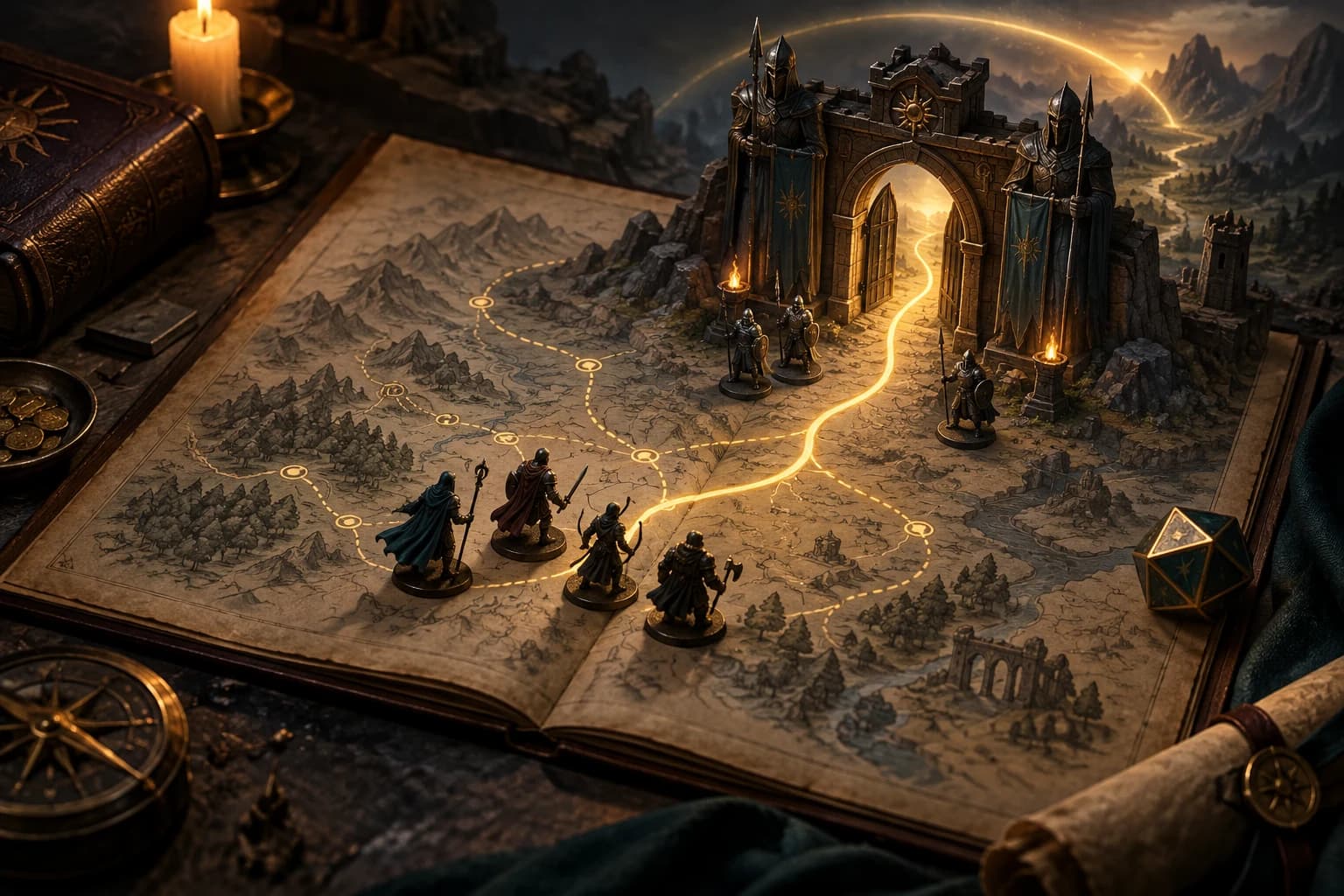
Jev could make an AI game master faster by handling the small decisions that delay a turn: interpreting an attempted action, selecting a workflow, or evaluating a possible NPC reaction. The opportunity is to shorten the work before the story can continue. The size of the improvement depends on how much of the player's wait those decisions currently consume.
TypeSafe introduced Jev on September 15, 2026, in early access. Its launch describes a System One model for typed decisions rather than free-form text generation, reporting 70–500 ms responses and 40–200× speedups on suitable queries. These are vendor-reported figures, not Playworlds results. TypeSafe's Jev announcement.
For an AI RPG, that suggests a useful pairing: a fast decision model helps the game choose what happens next, while a language model turns the resolved outcome into a scene. The following is our proposed gameplay design, not an implemented Jev integration.
Want to step into an AI adventure? Play Playworlds: find a setting you like and decide what your character does first.
Why an AI game master can take too long
The player writes: “I slip past the guard while my companion distracts him.” It is one sentence, but a game may need to answer several questions before describing the result.
Who is being addressed? Is the player attempting stealth, conversation, or combat? Is a companion available? Is the intended destination reachable? Does the action require a roll? Which information should enter the next narration prompt?
Some answers already exist in the game state. Others require interpretation. If the application asks a general language model to handle each question in a separate sequence, the waits can accumulate before the first useful word reaches the player.
Start by inspecting that sequence. Removing a redundant call or replacing a known fact with a direct lookup can be more valuable than switching models. A fast model is most useful when there is a real interpretive decision left to make.
What is a System One model?
TypeSafe's documentation describes three question types: Choice selects an option, Score evaluates a rubric, and Noul returns a value from zero to one for a statement. Questions can share a call but are evaluated independently against the supplied state. Choice and Score also return confidence. TypeSafe documentation.
That interface suggests a different way to design an AI game master. Instead of asking for an unrestricted plan and trying to interpret the prose, define the decisions the game can actually use. Keep the surrounding code responsible for combining them.
For example, an action classifier might choose between sneak, talk, attack, inspect, and other. A separate question might assess whether the wording requests help from a companion. These labels are an illustrative application design, not TypeSafe API syntax.
Where Jev could fit in an RPG turn
Gameplay job | Proposed approach | Why |
Interpret a free-text action | Evaluate Jev against a small set of supported intents | The output can select a defined workflow. |
Assess an NPC's response category | Test choices such as suspicious, cooperative, or evasive | The narrator can express the selected reaction in character. |
Check inventory or remaining movement | Read authoritative game state | Stored facts do not need a probabilistic answer. |
Resolve dice and apply damage | Execute the game's rules | Mechanical outcomes should be reproducible and auditable. |
Untangle a complicated quest choice | Use a deeper reasoning step when needed | Several dependent facts may need consideration together. |
Write the scene and dialogue | Use a language model such as Luna or Sol | The player needs readable, expressive narration. |
These are candidates for testing, not claims that Jev has demonstrated each behavior in Playworlds.
A faster workflow for the guard encounter
First, load a small, current state snapshot: the guard's location, the player's position, the companion's availability, and the relevant rules. Exclude facts the decision does not need.
Next, ask independent interpretation questions together. The action's apparent intent and whether it requests a distraction can be evaluated against the original message. A decision that depends on a completed roll must wait for that roll; placing dependent questions in the same batch does not remove the dependency.
Then let the engine check prerequisites and resolve the attempt. If the companion is absent, the game should not silently invent their participation. If the action is unclear, ask the player a short clarification or route it to a more capable interpreter.
Finally, give the narrator the accepted outcome. For example: the distraction succeeds, the player reaches the archway, and the guard notices a dropped clasp but does not identify its owner. The narrator can make that moment vivid without changing the result halfway through the paragraph.
The player experiences one continuous scene. Internally, each part has a specific job, and the engine commits the resulting state once.
Your own approach might be a bluff, a bargain, or a closer look at the surroundings. Choose your next adventure in Playworlds and bring that intent into the scene.
Does a 100× faster decision mean a 100× faster game?
No. Consider an illustrative turn with three sequential interpretation calls, each taking two seconds, followed by four seconds of narration:
3 × 2 seconds + 4 seconds = 10 seconds
Now suppose each interpretation call takes 0.1 seconds:
3 × 0.1 seconds + 4 seconds = 4.3 seconds
The decision calls became 20× faster, but the whole turn became about 2.3× faster, a 57% reduction in waiting time. If all three decisions are independent and one batch completes in 0.1 seconds, the illustrative total becomes 4.1 seconds.
These numbers are invented to explain the arithmetic. They are not observations of Jev or Playworlds. The example assumes sequential phases and omits retrieval, validation, network overhead, and speech generation.
There is still a substantial opportunity here. Cutting a long pause by several seconds can change the rhythm of an investigation or conversation. But once narration becomes the slowest stage, further decision-speed improvements have a smaller effect on the total. Measure the full path from submitting an action to receiving a usable result.
Type-safe does not mean correct about the story
TypeSafe's launch distinguishes guaranteed schema matching from its broader performance claims. It also notes that its headline workflow gains are likely toward the upper end of real-world improvements, and that the published speed evaluations generally ran from the US West Coast. TypeSafe's benchmark qualifications.
A response can fit the required type and still be the wrong decision. Choosing attack when a player intended a bluff is a valid label with an unwanted consequence. Similarly, a plausible NPC reaction can contradict a promise made earlier if the relevant fact was missing from the input.
Treat uncertainty as part of the game flow. Test confidence thresholds on representative actions, preserve an other route, and make ambiguous cases recoverable. Confidence is useful only if it helps the application decide when to act and when to seek more information.
How to prove a game-master speed improvement
A useful test set should include ordinary conversations, ambiguous actions, combat attempts, compound requests, and scenes requiring earlier clues. Run the same saved states through the existing workflow and the proposed one.
Measure both speed and the consequences of errors:
- First useful response: when the player receives information they can act on, not merely a loading acknowledgment.
- Completed turn time: when narration and accepted state changes are ready.
- Median and p95 latency: the typical wait and the slower turns that disrupt a session.
- Decision accuracy and fallback rate: how often the intended action is recognized, and how often another step is needed.
- State consistency: whether inventory, position, resources, and quest facts agree after the turn.
- Cost per completed turn: all calls, retries, and fallbacks included.
An initial experiment could evaluate Jev alongside the current interpreter without letting it change live game state. Compare disagreements first. Only then decide which narrow decision is safe and useful to move into the active workflow.
What this could mean for Playworlds
The goal is an adventure that keeps pace with curiosity: ask another question, inspect another clue, try another approach. Jev is a candidate for reducing the interpretation delays inside that experience. A full game still needs reliable rules, persistent state, and satisfying narration.
This article describes a possible architecture; it does not announce that Playworlds uses Jev. To explore the existing adventure format, choose a world in Playworlds. For ideas on expressing your character's intent, read our guide to writing roleplaying actions.
Frequently asked questions
Can Jev replace an entire AI dungeon master?
It is better considered for specific decisions inside the game-master workflow. In the proposed design, a separate narrator writes the scene and the game engine owns mechanics and saved state.
Is Jev faster than GPT-6 Luna or Sol for RPGs?
We have not run an RPG comparison. A useful test would compare identical decisions, context, regions, and output requirements, then measure the complete turn rather than only one provider call.
Can Jev and GPT models work together?
Yes, an application can combine a decision service with a text-generation service. The critical step is to pass validated outcomes between them so narration matches the state that was actually saved.
Should every game-master check use AI?
No. Use deterministic code for known rules and stored facts. Reserve model calls for interpretation that ordinary logic does not adequately handle.
Give your next adventure a first move
Pick a world, meet the situation, and decide how your character responds. Start playing Playworlds →